Understanding Your 2026 Property Assessment and Property Taxes
The Village understands that many property owners are seeing significant changes in their assessed values following the 2026 community-wide revaluation. We also understand that seeing a large increase can be concerning, particularly when trying to determine what it means for your property tax bill.
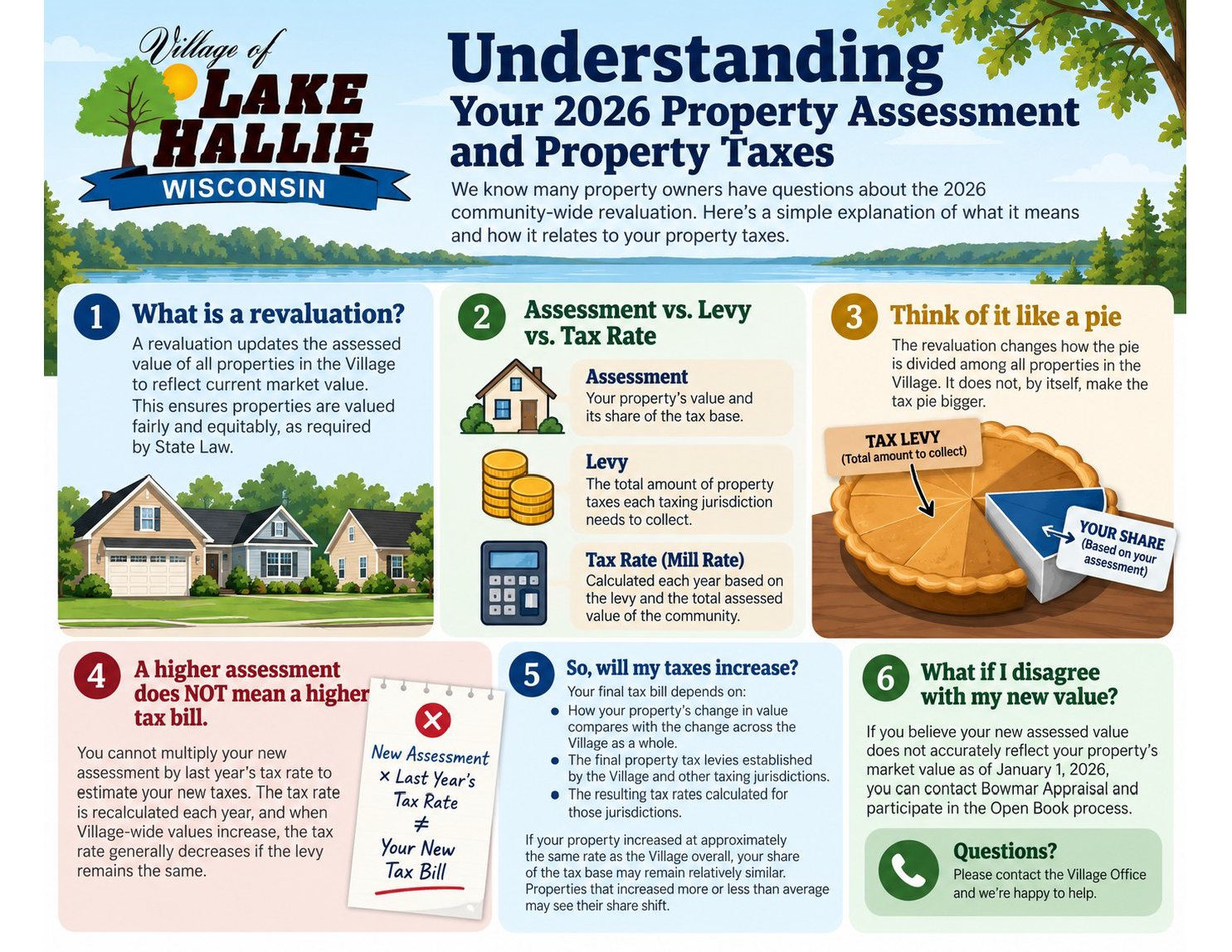
The most important thing to know: An increase in your assessed value does not mean your property taxes will increase by the same percentage.
Why can't I use last year's tax rate?
One common way property owners are trying to estimate their new taxes is by multiplying their new assessed value by last year's tax rate (mill rate).
This will not provide an accurate estimate of your 2026 property taxes.
The tax rate is recalculated each year. Because the revaluation changes the assessed values of properties throughout the Village, the total assessed value of the Village will also change significantly.
Think of it like a pie
The tax levy is the total amount of property taxes that a taxing jurisdiction needs to collect.
Your assessment helps determine your share of that levy.
A revaluation changes how the pie is divided among property owners. It does not, by itself, make the tax pie bigger.
For example, if property values throughout the Village increased substantially, the tax rate would generally decrease if the levy remained the same.
That means:
A 40% increase in assessed value does NOT automatically mean a 40% increase in property taxes.
So, will my taxes increase?
Your final tax bill depends on several factors, including:
How your property's change in value compares with the change across the Village as a whole
The final property tax levies established by the Village and other taxing jurisdictions
The resulting tax rates calculated for those jurisdictions
If your property increased at approximately the same rate as the Village overall, your share of the tax base may remain relatively similar. Properties that increased more or less than the Village overall may see their share shift.
Your total property tax bill also includes taxes from other jurisdictions, such as Chippewa County, your school district and the technical college. Each establishes its own levy.
What if I disagree with my new property value?
That is a separate question from how property taxes are calculated.
If you believe the new assessed value does not accurately reflect your property's market value as of January 1, 2026, we encourage you to contact Bowmar Appraisal and participate in the Open Book process.
The takeaway
New Assessment × Last Year's Tax Rate ≠ Your New Tax Bill
Your new assessment establishes your property's value and its share of the tax base. The tax levies determine how much must be collected, and the tax rates are calculated afterward.
We recognize that this process can be confusing, particularly following a community-wide revaluation. The Village will continue sharing information as it becomes available so property owners can better understand both the revaluation process and their property taxes.